Pledge your device
to the science
you support
VEGA Compute turns mobile devices into real collective computing power.
A modern iPhone is a small supercomputer. Almost every night it sits idle on a charger for hours. VEGA puts that idle time to work on real scientific datasets, chunk by chunk, on the phone, without ever sending your personal data anywhere. Instead of one team paying for a datacenter, thousands of people each contribute a few hours of overnight compute to a campaign they care about. You pick the campaign. Your phone does the math. You wake up to a receipt of what you contributed. Nothing about you ever leaves your phone; only answers to science problems do.
Plug in
Charge your phone overnight like always.
Compute
Your phone computes small pieces of a dataset while you sleep.
Wake up
See and share your contribution. Unplug anytime.
Coming soon to the App Store
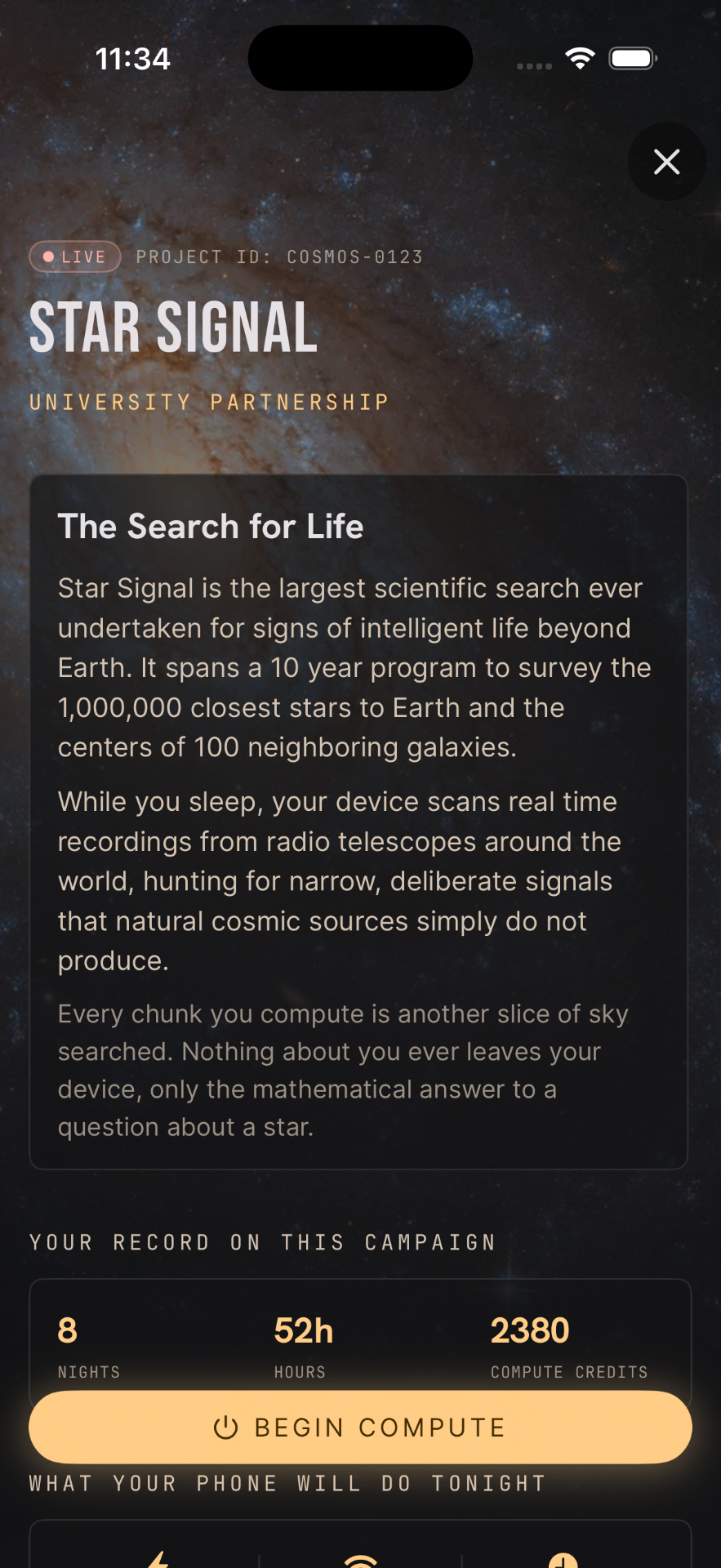
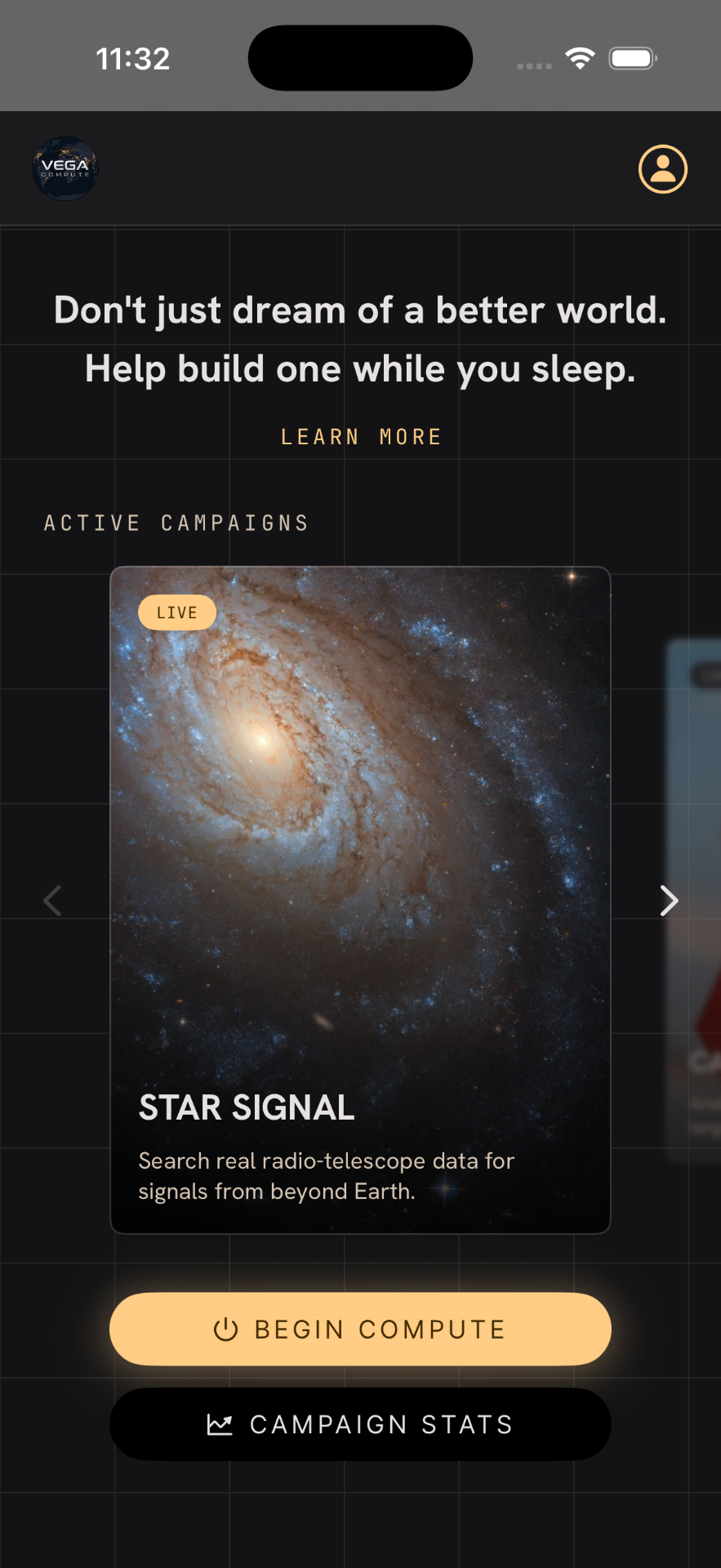
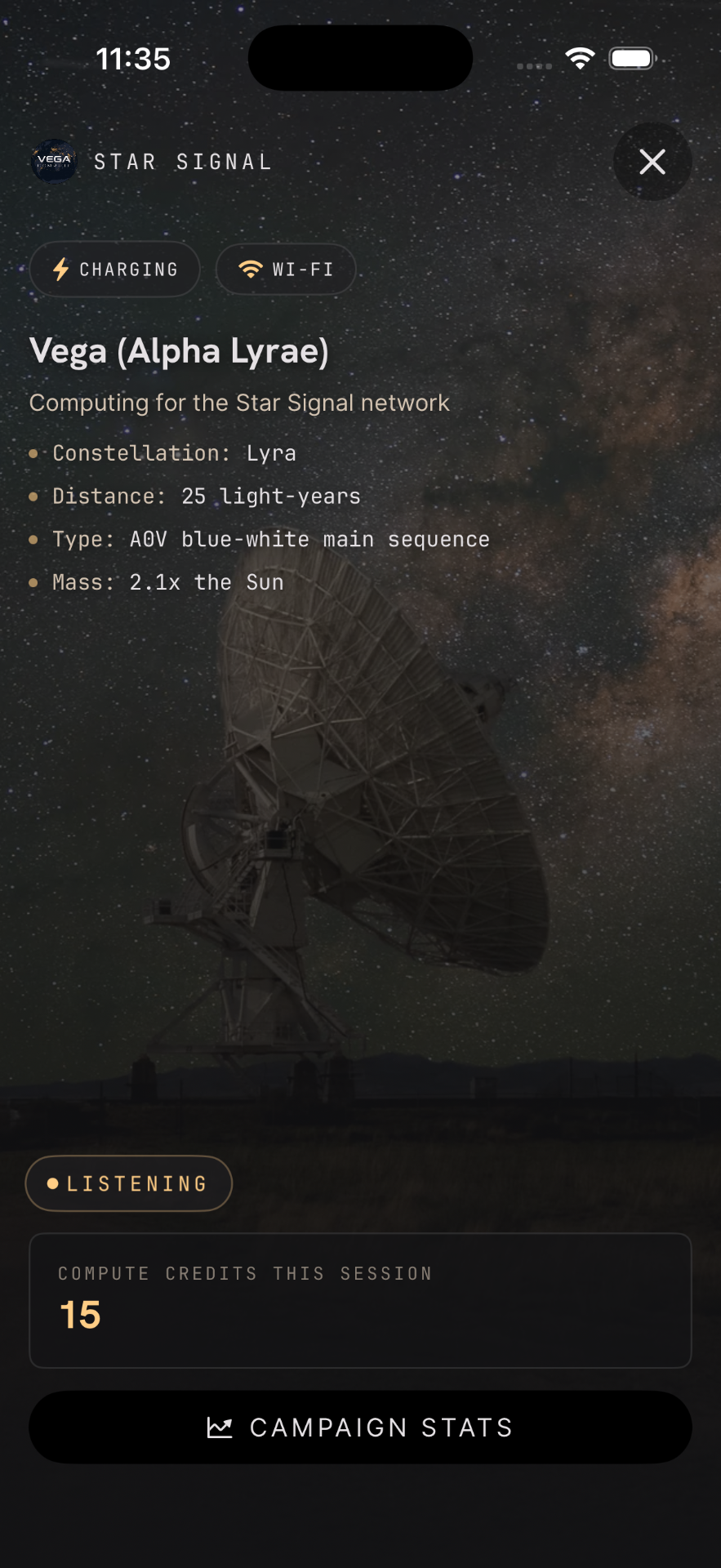
App preview. Example campaign shown.
Add your email and we'll let you know the moment the app is available.
Built for campaigns like these
No campaign is live yet. These are the shapes of work VEGA was engineered to run, and an open invitation to the researchers who run them.
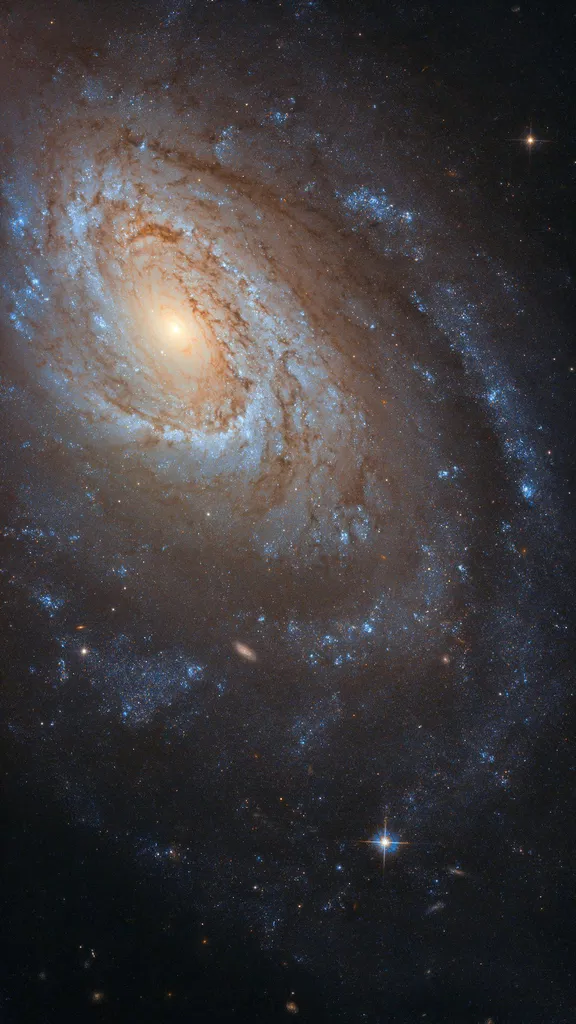
Star Signal
Skim petabyte-class public survey archives for rare, structured signals. Our reference build runs a narrowband search across publicly released radio telescope data, the same class of analysis used in modern technosignature research. Built, benchmarked, and waiting for a partner.

Molecular Screening
Screen millions of candidate compounds against the protein targets behind cancer and other diseases. Each phone tests molecules while its owner sleeps, helping researchers shortlist pharmaceutical treatments for lab trials.
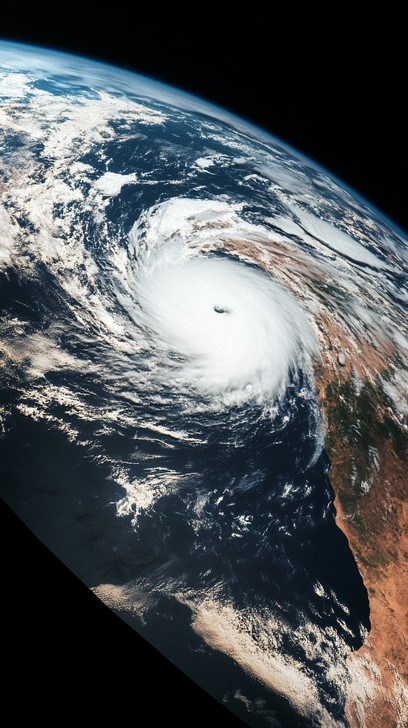
Climate Research
Run independent members of large climate ensembles: storm track variations, flood scenarios, downscaled regional projections. Each phone computes one scenario variant per pass. Together the fleet maps the range of outcomes that no single machine has time to explore.
Have a dataset shaped like this? See if your workload fits.
At its peak, the largest volunteer computing project in history took in about 35 GB of data per day across its entire global network. One phone, one night, can now process roughly three times that.
Assumptions · 6h charging window · duty factor 0.5 · 2 MiB per chunk · 50 ms per chunk at 1× · network cap 50,000 chunks / device / night · cloud framing at $0.05/vCPU-hour.
Assumptions · 6h charging window · duty factor 0.5 · 2 MiB per chunk · 50 ms per chunk at 1× · network cap 50,000 chunks / device / night.
All values above derive from a single source: 2 MiB per work unit, 50 ms of core math per chunk at baseline depth, a 6-hour charging window, and a duty factor of 0.5 to leave generous margin for thermal management, background tasks, and network variability. Per-device output is capped at 50,000 chunks per night at baseline depth; deeper searches multiply the compute per chunk, so per-device throughput divides while utilization rises toward 100%. Cloud-equivalent framing uses a public on-demand rate of $0.05/vCPU-hour for a general-purpose core. For context, the largest historical volunteer computing project peaked at about 35 GB of daily intake across its entire global network. These are engineering estimates for shape and scale; real campaign reports will land on the results page once measured in the field.
Have a dataset that needs more compute than your budget allows? VEGA runs campaigns for scientific institutions at a fraction of the cost of dedicated hardware.